
 Share
Share
LifeStance, in partnership with Researchscape International, conducted a survey to explore topics commonly addressed in therapy around the holidays, including seasonal stress, navigating social gatherings, performative happiness, loneliness and managing family discussions about politics and current events.
2025 Holiday Mental Health Report
Purpose of the Research
Methodology
On behalf of LifeStance Health, Researchscape International conducted an online survey of 1,023 U.S. adults aged 18 and older. The survey was fielded from October 16 to 21, 2025. The credibility interval is plus or minus four percentage points for questions answered by all respondents. The data was weighted to the U.S. population by nine demographic questions.
Summary of Findings
The findings reveal that for many Americans, the holiday season involves a complex mix of emotions, including reported feelings of stress and pressure. These trends are particularly pronounced among younger generations.
Key Insights
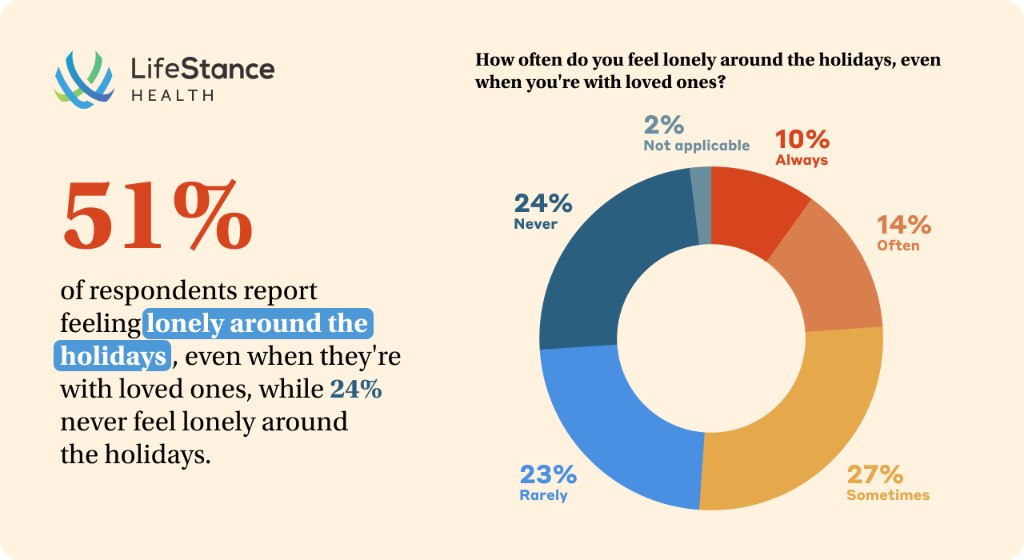
- 51% of respondents report feeling lonely around the holidays, even when they’re with loved ones, while 24% never feel lonely around the holidays.
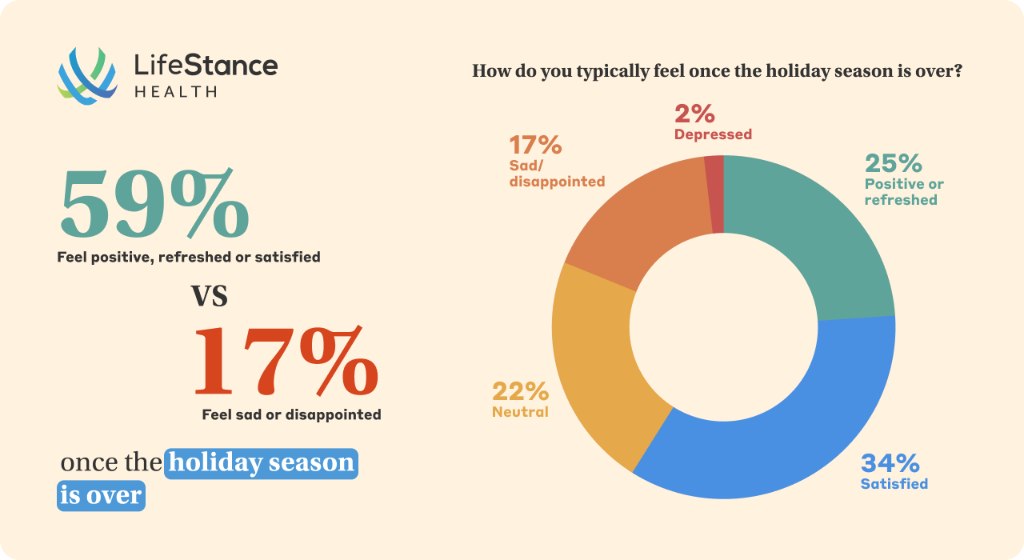
- 59% of respondents typically feel positive, refreshed or satisfied once the holiday season is over, while 17% feel sad or disappointed.
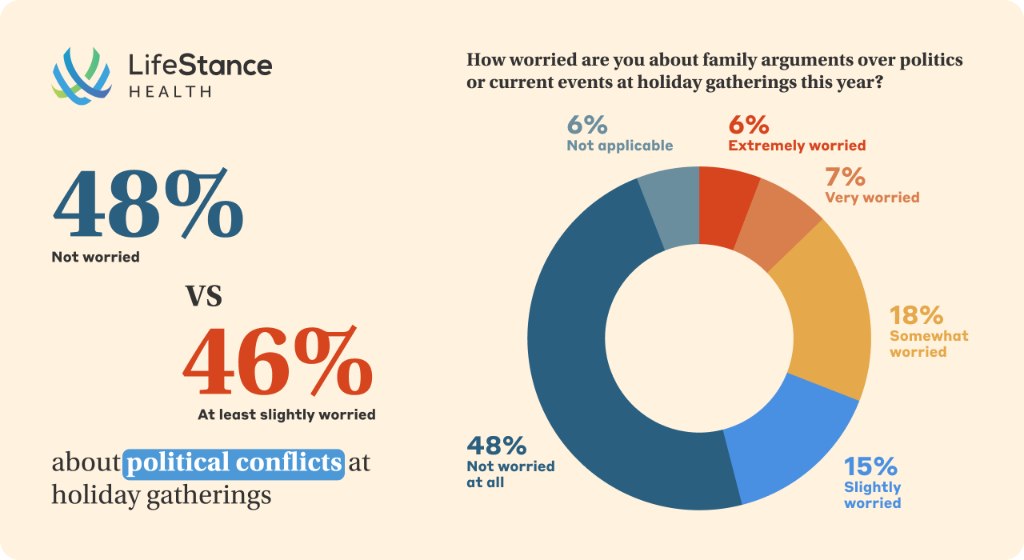
- 48% of respondents are not worried about political conflicts at holiday gatherings, while 46% are at least slightly.
- 57% of respondents find the holiday season stressful. However, 23% report that it is at least slightly relaxing.
- 64% of respondents would prefer to skip at least a few of their holiday gatherings, while 28% would like to attend all of them.
- Millennials (34%) and Gen Z (33%) were the most likely to want to skip most or all of their holiday gatherings, while 20% of millennial and 26% of Gen Z respondents said they want to attend all of them.
- 75% of respondents said at least a few of their planned holiday gatherings feel more like an obligation than something they truly want to attend, with Gen Z leading at 89%. Meanwhile, 20% said they truly want to attend.
- 69% of respondents feel at least a little pressure to appear happier than they actually are during the holidays, with millennial (34%) and Gen Z (35%) respondents experiencing a high degree of pressure. Conversely, 31% do not feel any pressure to appear happier.


Conclusion
Feeling stress during the holiday season is a common experience, and people facing these challenges are not alone. LifeStance is committed to making outpatient mental health care accessible and convenient. Many LifeStance providers offer flexible scheduling and remote visits, so individuals can support their mental health this holiday season without rearranging their schedules. If you’re experiencing stress, find a mental health professional now.
Subscribe to Our
LifeStance Newsletter
Authored By


Related

September 29, 2026
Nearly Half of Americans Say Fear of an Unwanted Viral Moment Keeps Them from Being Themselves in Public, LifeStance Survey Finds
Read More
August 31, 2026
TMS Therapy for Treatment-Resistant Depression: Real World Clinical Outcomes in More than 350 Patients
Read More
August 11, 2026
One in Three Women Don’t Know Perimenopause Can Affect Their Mental Health, New LifeStance Survey Finds
Read More
June 19, 2026
From Gen Z to Boomers, Coast to Coast: LifeStance Care That Helps People Feel Better
Read More
March 27, 2026
Measuring Outcomes of Depression and Anxiety Treatment: LifeStance Insights
Read More
October 31, 2025
Learn How LifeStance is Simplifying Mental Health Care Referrals for Medical Providers
Read More


December 8, 2023